curve_contrast() computes the difference between effect curves across levels of a subgrouping variable supplied to by in the original call to adrf().
Arguments
- x
an
effect_curveobject; the output of a call toadrf()withbysupplied.
Value
An object of class contrast_curve, which inherits from effect_curve, with additional information about the groups being contrasted.
Details
curve_contrast() creates a new effect curve corresponding to the difference between effect curves in two groups. When multiple subgroups are specified by by in the original call to adrf(), all pairwise comparisons are included. Use the subset argument in the original function call to restrict comparisons to fewer groups.
See also
adrf()for computing the ADRFreference_curve()for comparing effect curves to a point along the curveplot.effect_curve()for plotting the effect curve contrastssummary.curve_est()for performing tests of effect curve contrasts at specific pointssummary.effect_curve()for performing omnibus tests of effect curve contrasts (e.g., whether the contrast curve differs from 0)
Examples
data("nhanes3lead")
fit <- lm(Math ~ poly(logBLL, 5) *
Male * Smoke_in_Home *
(Age + Race + PIR),
data = nhanes3lead)
# ADRFs in Race subgroups, excluding Other
adrf_by <- adrf(fit, treat = "logBLL",
by = ~Race,
subset = Race != "Other")
adrf_by
#> An <effect_curve> object
#>
#> - curve type: ADRF
#> - response: Math
#> - treatment: logBLL
#> + range: -0.3567 to 2.4248
#> - by: Race
#> - inference: unconditional
#>
# Contrast subgroup ADRFs
adrf_contrast <- curve_contrast(adrf_by)
adrf_contrast
#> An <effect_curve> object
#>
#> - curve type: ADRF contrast
#> - response: Math
#> - treatment: logBLL
#> + range: -0.3567 to 2.4248
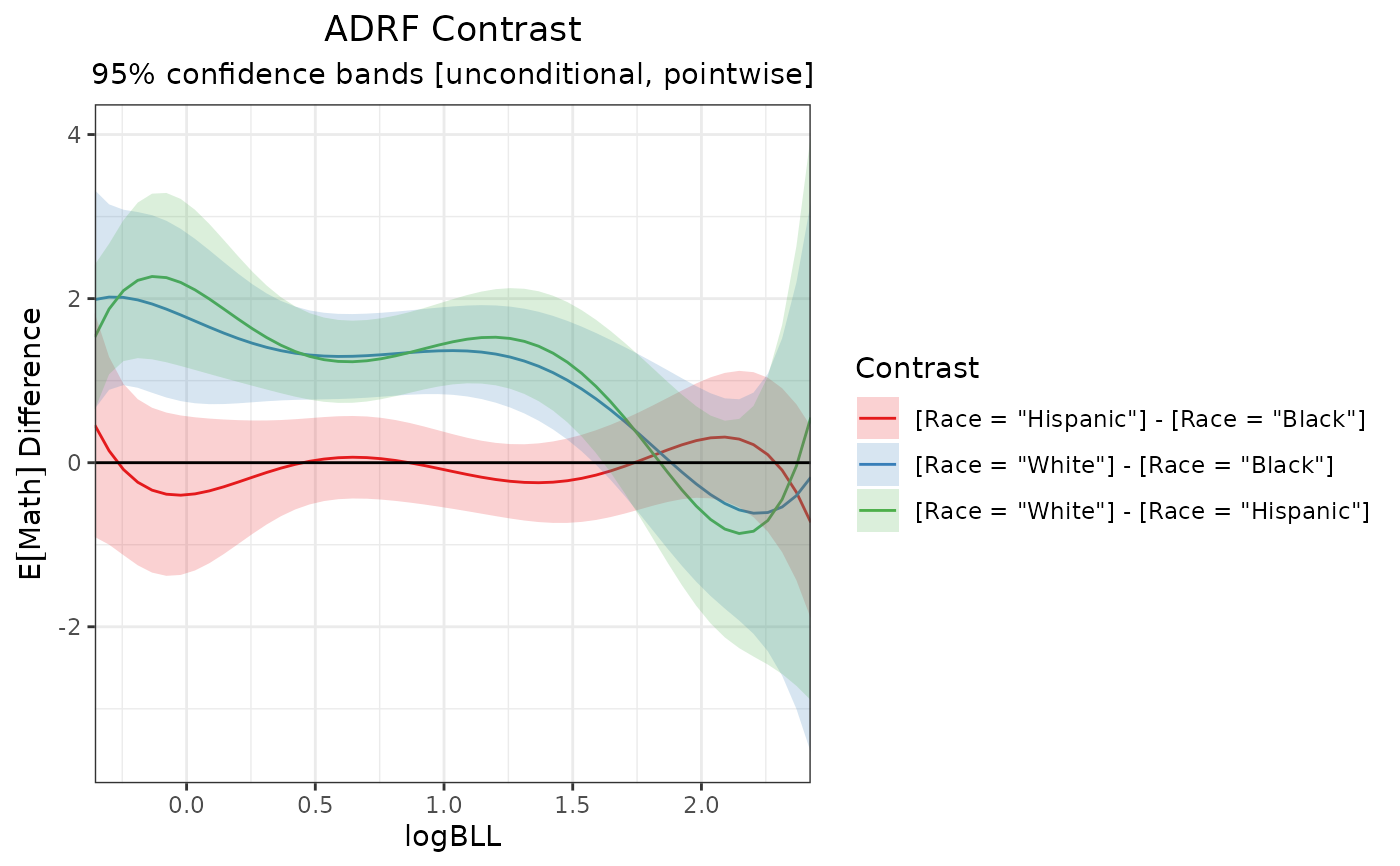
#> - contrasts: [Race = "Hispanic"] - [Race = "Black"], [Race = "White"] - [Race = "Black"], [Race = "White"] - [Race = "Hispanic"]
#> - inference: unconditional
#>
# Plot contrast ADRFs
plot(adrf_contrast, simultaneous = FALSE)
 # Compute and test difference between subgroup
# ADRFs at specific points
adrf_contrast(logBLL = c(0, 2)) |>
summary()
#> ADRF Contrast Estimates
#> ─────────────────────────────────────────────────────────────────────────
#> Contrast logBLL Estimate Std. Error t
#> [Race = "Hispanic"] - [Race = "Black"] 0 -0.3926 0.4885 -0.804
#> [Race = "Hispanic"] - [Race = "Black"] 2 0.2837 0.3625 0.783
#> [Race = "White"] - [Race = "Black"] 0 1.7703 0.5265 3.362
#> [Race = "White"] - [Race = "Black"] 2 -0.3083 0.6162 -0.500
#> [Race = "White"] - [Race = "Hispanic"] 0 2.1629 0.5120 4.225
#> [Race = "White"] - [Race = "Hispanic"] 2 -0.5921 0.6297 -0.940
#> ─────────────────────────────────────────────────────────────────────────
#> Inference: unconditional, simultaneous
#> Confidence level: 95% (t* = 2.59, df = 2377)
#> Null value: 0
# Test if ADRF differences are present
summary(adrf_contrast)
#> Omnibus Curve Test
#> ───────────────────────────────────────────────────────
#> H₀: ADRF contrast is 0 for values of logBLL between
#> -0.3567 and 2.4248
#>
#> Contrast P-value
#> [Race = "Hispanic"] - [Race = "Black"] 0.8620
#> [Race = "White"] - [Race = "Black"] 0.0006
#> [Race = "White"] - [Race = "Hispanic"] 0.0002
#> ───────────────────────────────────────────────────────
#> Computed using the Imhof approximation
# Compute and test difference between subgroup
# ADRFs at specific points
adrf_contrast(logBLL = c(0, 2)) |>
summary()
#> ADRF Contrast Estimates
#> ─────────────────────────────────────────────────────────────────────────
#> Contrast logBLL Estimate Std. Error t
#> [Race = "Hispanic"] - [Race = "Black"] 0 -0.3926 0.4885 -0.804
#> [Race = "Hispanic"] - [Race = "Black"] 2 0.2837 0.3625 0.783
#> [Race = "White"] - [Race = "Black"] 0 1.7703 0.5265 3.362
#> [Race = "White"] - [Race = "Black"] 2 -0.3083 0.6162 -0.500
#> [Race = "White"] - [Race = "Hispanic"] 0 2.1629 0.5120 4.225
#> [Race = "White"] - [Race = "Hispanic"] 2 -0.5921 0.6297 -0.940
#> ─────────────────────────────────────────────────────────────────────────
#> Inference: unconditional, simultaneous
#> Confidence level: 95% (t* = 2.59, df = 2377)
#> Null value: 0
# Test if ADRF differences are present
summary(adrf_contrast)
#> Omnibus Curve Test
#> ───────────────────────────────────────────────────────
#> H₀: ADRF contrast is 0 for values of logBLL between
#> -0.3567 and 2.4248
#>
#> Contrast P-value
#> [Race = "Hispanic"] - [Race = "Black"] 0.8620
#> [Race = "White"] - [Race = "Black"] 0.0006
#> [Race = "White"] - [Race = "Hispanic"] 0.0002
#> ───────────────────────────────────────────────────────
#> Computed using the Imhof approximation